Benevity
01
ORG DESIGN · TEAM BUILDING · ENTERPRISE SAAS
Building a Design Function from Nothing
Company
Benevity
Role
Director, Product Design
Timeline
2015-2022
Team Growth
1-16
Company Outcome
$1.3B valuation

Above: Benevity’s flagship employee engagement software, Spark

Above: Benevity’s mobile app
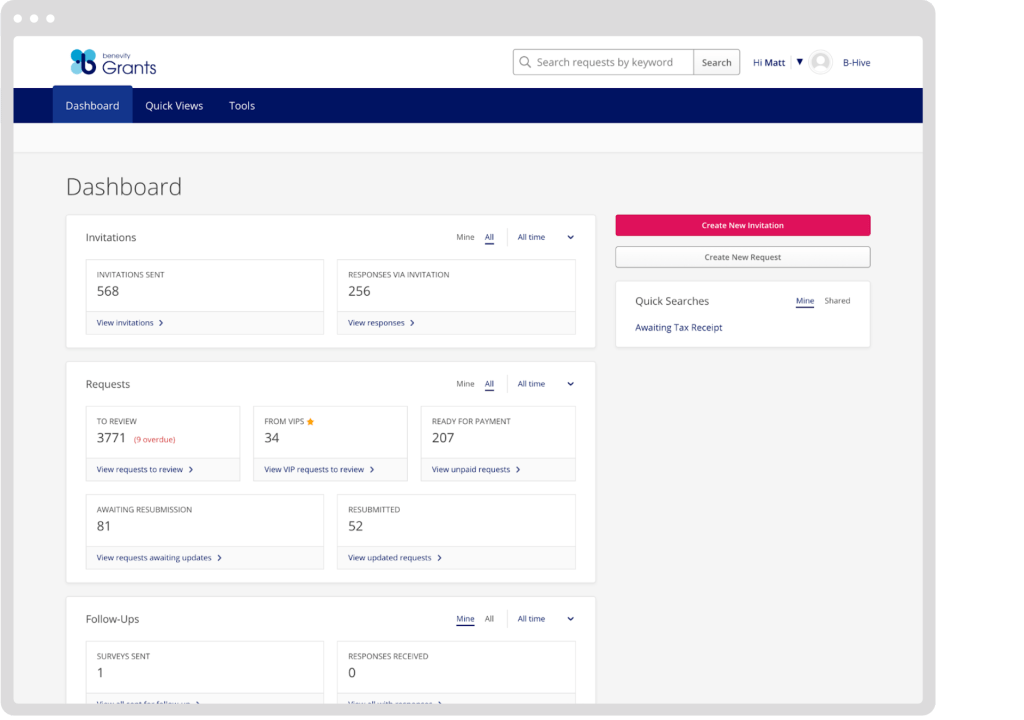
Above: Benevity Grants
The Situation When I joined Benevity, design was handled by one or two external contractors and there was no internal design function to speak of. Over the next few years, the company grew dramatically, adding new product lines, acquiring companies, and expanding into mobile. The design team grew with it. Building that team wasn’t a single decision. It was a series of deliberate choices about when to add people, what kinds of people to add, and how to structure a function that could keep pace with a company scaling toward a $1.3B valuation.
The Approach The team grew in response to genuine product expansion. When Benevity moved into net-new territory, like Grants, which required rebuilding an acquired product called Grantstream from the ground up, we added a designer. When something was an extension of existing work, like our mobile app, we started by putting an existing designer on the groundwork, earned the organizational buy-in, then added a resource if the work demanded ongoing attention. I led several design sprints to set the direction for the mobile app and oversaw its evolution from a basic web-based experience to a fully reworked native product. I also served as Product lead on the acquisition of Chaordix, later the foundation of Benevity’s Employee Resource Groups product, evaluating its design maturity, proposing three strategic directions for integration, and painting out what each could become before handing off to Product Management. The team’s early composition was deliberately senior-heavy but flat: we needed designers who could hold their own in product and engineering conversations without much support. The shift toward hiring younger designers came when we felt confident we could mentor them well, and when the organization’s design literacy had grown enough that a junior designer wouldn’t spend their days explaining what design was. At that point we were a team of four, and the foundation felt solid enough to build on.
The Outcome Over seven years I grew the team from one person to sixteen people spanning design, research, content, and design systems. Formalizing research was a turning point. The team had developed its own frameworks before we had a dedicated researcher, but that hire professionalized everything, allowing us to go deeper into clients’ organizations and, critically, to look and sound like a team that took research seriously. The moment I knew we’d genuinely made it was when we completed the first major redesign and relaunch of Skyline, our design system. That was when scrappy became something else. The outcome I’m most proud of has nothing to do with any screen: alumni from that team have gone on to senior roles at Dropbox, Shopify, the BC Government, and Jane App.