Skyline
02
DESIGN SYSTEMS · CROSS-FUNCTIONAL LEADERSHIP
Skyline: The Design System as Social Contract
Company
Benevity
Role
Director, Product Design
Timeline
2018-2022
Build duration
~2-3 years to adoption
Status
Live https://skyline.benevity.org
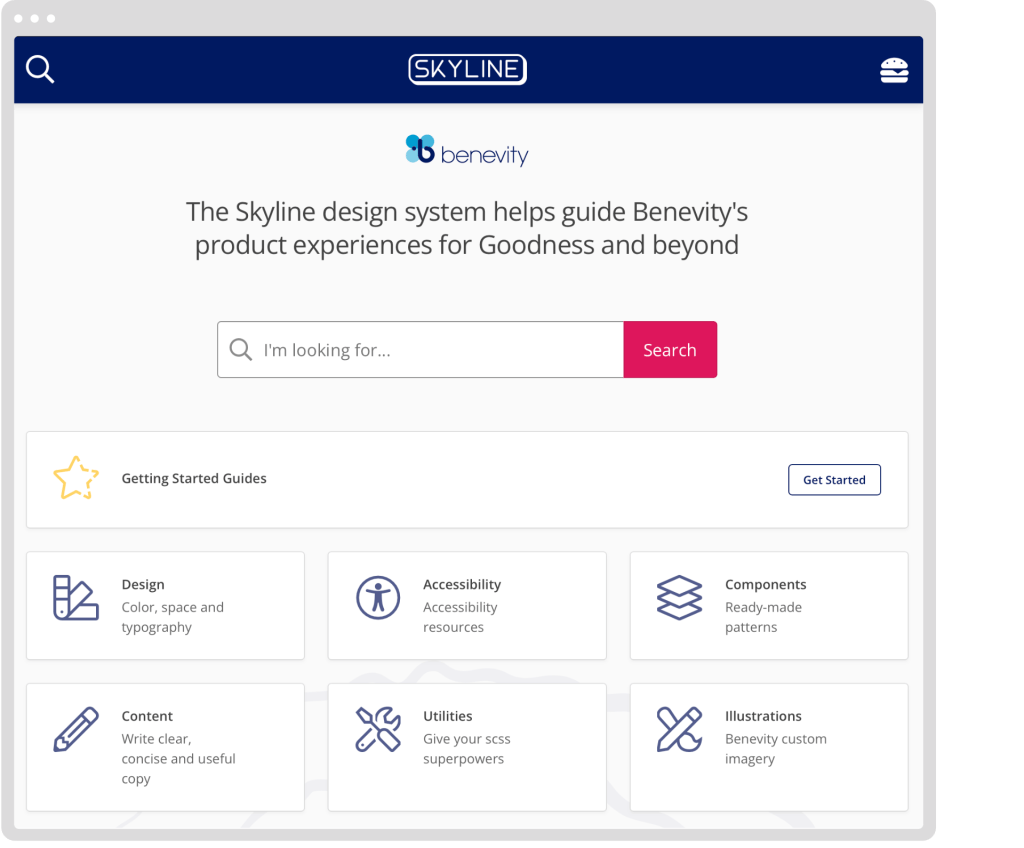
The Situation By 2017, Benevity had grown into a multi-product platform that had been built quickly and included several acquisitions. And you could tell. Each module had accumulated its own visual decisions over years of separate teams working in isolation. Before Figma, version control was a nightmare: designers attached files to Jira tickets, engineers implemented whatever version they had access to, and the same component could look subtly different in a dozen places. This was a scaling problem masquerading as a cosmetic one, and it was only going to get worse.
The Approach I understood early that the technical problem—reusable components, tokens, documentation—was the easy part. The hard part was organizational. You need engineering to treat the design system as infrastructure and commit real developer time to it. You need designers to believe that constraints are freedom. The most common response I got from engineering leads in the early years was some version of: “I can’t give up a developer to work on this full time.” I didn’t win that argument by making the argument. I won it by finding allies; individual engineers who had personally felt the pain of inconsistency, and moving things forward one component at a time without requiring organizational permission.
The Outcome I knew the shift was complete when, a year or two later, I proposed making Skyline public. I expected the same pushback. Instead, everyone said: “Yeah, why wouldn’t we?” That was the real measure. Not the component count, but the fact that the system had become something the whole organization was proud of. Skyline launched at skyline.benevity.org and remains in active use and development today.
Next: Missions: Doubling Adoption→
Previous:
Building a Design Function from Nothing